How to Choose Rubber Bump Stops in 2026?
Choosing Rubber Bump Stops in 2026 is not simply a matter of picking the hardest rubber available. The correct part must control travel, absorb impact, and survive repeated compression. A small mistake can create harsh rebound, premature cracking, or unwanted noise.
Dr. Alan N. Gent, a respected rubber science authority, offered a useful principle: “Rubber performance depends on deformation, temperature, and time.” That principle still matters when selecting modern Rubber Bump Stops. A bump stop fitted to a delivery van may face different demands from one used in an off-road suspension. Load, stroke length, mounting space, and operating temperature must be checked together.
Start with the real application.
Measure the available clearance. Record the static load and expected impact load. Then examine the compression curve, not only the advertised hardness. Shore A hardness gives useful guidance, but it does not describe the whole behavior. Rubber compound, shape, voids, and rebound characteristics can change the result.
Material choice also deserves attention. Natural rubber may provide strong resilience, while polyurethane can offer better wear resistance in some environments. Neither material is automatically best. Oil, ozone, heat, water, and road salt may quietly shorten service life.
There is an uncomfortable detail. Catalog data may not match field conditions perfectly. Installation angle, surface finish, and misalignment can alter performance. I have found that a carefully measured “ordinary” solution often outperforms an impressive specification sheet. This guide explains how to compare these factors, question uncertain claims, and choose Rubber Bump Stops with greater confidence in 2026.
Define Bump Stop Function, Load Range, and Travel Requirements
How to Choose Rubber Bump Stops in 2026?
A bump stop is not merely a cushion.
It limits suspension travel, absorbs impact energy, and protects metal components during severe compression. Define its function before selecting a part. Is it a final travel limiter, a progressive spring, or an emergency overload buffer? Each role needs a different shape and stiffness curve. SAE suspension-testing guidance recommends evaluating force against displacement, not relying on hardness alone.
Load range must match real operating conditions. Record vehicle mass, payload, axle distribution, and impact speed. Then estimate the peak load at the stop, including a safety margin. A 2024 suspension materials review reported that elastomer force can rise sharply near full compression, sometimes changing by more than 50% within the final travel section. This makes static load data incomplete. Measure dynamic response when possible.
Travel requirements need equal attention.
Confirm normal ride clearance, available compression distance, and the stop’s installed height. ASTM D395 Method B measures compression set after 22 hours at 70°C, while ISO 815-1 provides related elastomer testing procedures. These tests help compare durability, but they do not reproduce every road impact.
I have seen designs pass bench testing yet bottom out on rough roads. Recheck clearance after aging, temperature changes, and repeated impacts. Small errors become loud impacts.
Match Rubber Hardness: Select Shore A Ratings from 40 to 90
How to Choose Rubber Bump Stops in 2026?
Shore A hardness controls how a rubber bump stop absorbs impact. The 40–90 range covers soft, flexible cushioning to firm motion control. A 40 Shore A stop compresses easily and reduces sharp vibration. It suits light covers, access panels, and low-force contact points. A 60 Shore A grade offers a practical balance for vehicle mounts and machinery guards. At 80–90 Shore A, compression is limited, but impact resistance and positional stability improve.
Do not choose hardness by number alone. ASTM D2240 and ISO 48-4 define indentation testing, yet test temperature, specimen thickness, and surface condition affect readings. The International Rubber Study Group’s 2024 statistical bulletin reported global natural-rubber consumption above 15 million tonnes in 2023. That scale reflects demanding transport and industrial applications, where compound selection cannot rely on hardness alone. Load, stroke, temperature, and repeated cycling matter too.
Test the real assembly.
For a 60 Shore A stop, measure compression under the actual load, then inspect permanent set after repeated impacts. I once treated a harder stop as automatically safer; it transferred too much force into the metal bracket. That choice was technically neat, but practically wrong. Allow extra margin for cold conditions, aging, and manufacturing variation. A 70 Shore A result may become unsuitable when the stop operates near its compression limit. Review the data after field testing, not just after catalog selection.
Calculate Compression Deflection and Safety Margin Under Peak Loads
How to Choose Rubber Bump Stops in 2026?
Calculate Compression Deflection and Safety Margin Under Peak Loads
Choosing a rubber bump stop starts with the peak load, not its outside diameter. Record the highest force during impact, vibration, or sudden travel. Add the weight transferred through the stop. Then identify the expected compression deflection at that load. Rubber rarely behaves like a perfect spring. Its stiffness changes with deflection, speed, temperature, and age.
Use a tested load-deflection curve whenever possible. If the curve shows 1,200 newtons at 8 millimeters, that point may suit your design. Do not assume the same ratio applies at 12 millimeters. Calculate the required safety margin with this simple check: safety margin equals allowable peak load divided by actual peak load, minus one. A result of 0.30 represents a 30 percent margin. For harsh impacts, a larger margin may be sensible.
Keep the stop away from permanent compression. Measure the available travel and reserve space for tolerances, mounting movement, and material swelling. Check performance at the lowest and highest operating temperatures. Humidity, oils, ozone, and repeated impacts can also change behavior. Small details matter.
Test the real assembly.
A spreadsheet can still mislead. I have seen acceptable calculations fail because the mounting plate flexed first. Inspect contact alignment, bolt preload, and compression after repeated cycles. Leave room for uncertainty, but do not hide it inside an oversized part. Oversizing can create excessive force and damage nearby components. Recheck the design after field measurements become available.
How to Choose Rubber Bump Stops in 2026?
Compare compression deflection and remaining safety margin under representative peak loads. The example uses a rubber bump stop with a 12 mm allowable compression limit and load-deflection values based on a progressive compression response.
Selection rule: choose a bump stop that keeps peak compression below the allowable limit while retaining a practical safety margin. In this example, the 2,000 N load point produces 8.0 mm compression and a 33.3% deflection margin; the 2,500 N point leaves only 16.7%, so a larger or stiffer stop should be considered for repeated peak loading.
Verify Dimensions, ISO 3302 Tolerances, and Service-Life Testing Data
How to Choose Rubber Bump Stops in 2026?
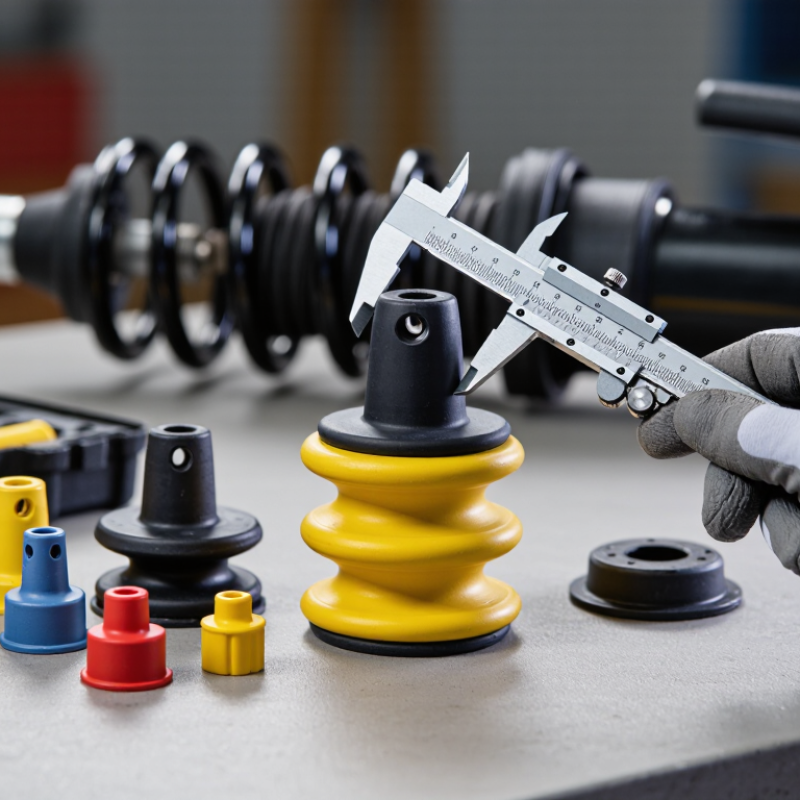
Choosing a rubber bump stop starts with measurements, not appearance. Record its diameter, height, mounting hole, thread size, and working direction. Measure the installed gap with calipers, because painted surfaces can hide small errors. Check hardness, usually stated as Shore A, but do not treat hardness as load capacity. Two compounds with equal hardness may behave differently under compression.
Ask the supplier to state the ISO 3302 tolerance class on the drawing. This standard helps control molded rubber dimensions, but it does not replace a complete specification. Confirm tolerances for height, diameter, hole position, and flash. A loose tolerance can create uneven contact or unwanted vibration. I have seen suitable-looking parts fail because the mounting hole was slightly misaligned. Small details matter.
Service-life data should match your real conditions. Request compression-set results, temperature-aging data, ozone exposure results, and repeated-load testing. Ask how many cycles were completed and what failure limit was used. Test data without temperature, load, and time details is weak evidence. Include oil, water, dust, and outdoor exposure when relevant. Laboratory results still need field validation. That step is often skipped. It should not be. Review load-deflection curves at the expected temperature, then compare them with the actual machine movement. A short trial installation can reveal noise, permanent deformation, or mounting stress before full production.